
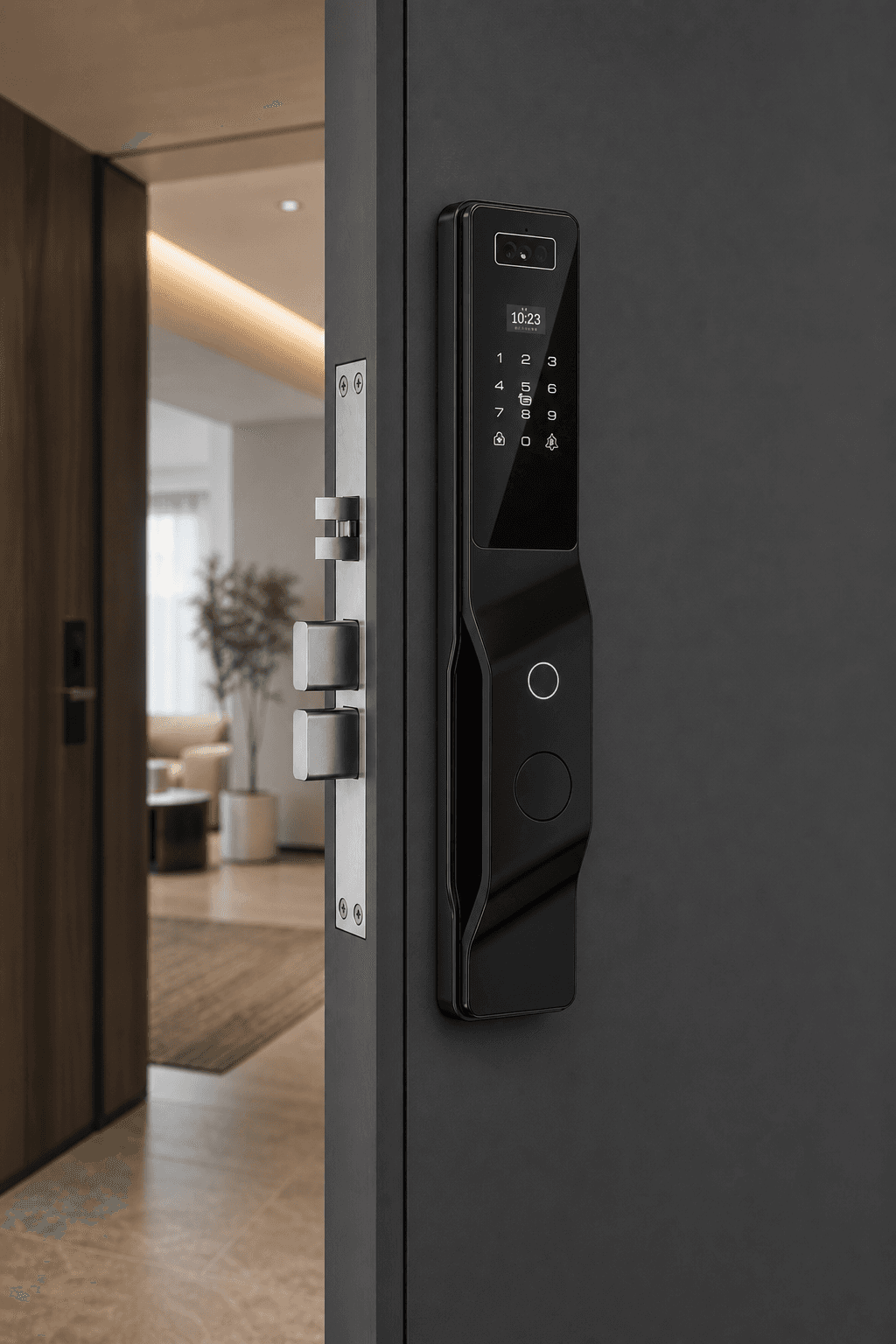
Property managers, apartment operators, and vacation-rental businesses need more from a smart lock than convenient keyless entry. When dozens or hundreds of doors are involved, connectivity architecture can affect remote access management, network design, battery maintenance, installation complexity, and long-term operating costs.
Two common approaches are direct Wi-Fi smart locks and Bluetooth Low Energy (BLE) smart locks used either independently or with gateways. Neither architecture is universally better. The right choice depends on the property type, number of doors, management platform, remote-access requirements, and infrastructure available at the site.
For smart-lock brands, property developers, distributors, and system integrators, understanding these differences is also important when specifying an OEM/ODM smart lock solution for rental-property projects.
1. Direct Wi-Fi vs BLE: What Is the Main Difference?
The fundamental difference is how the lock communicates with other devices and management platforms.
A direct Wi-Fi smart lock can connect to a compatible Wi-Fi network without requiring a separate Bluetooth gateway for that communication path. Depending on the product configuration and software platform, this can simplify remote connectivity for individual apartments, vacation rentals, and other relatively small deployments.
A BLE smart lock communicates locally using Bluetooth Low Energy. Some BLE systems can perform important access-control functions at the lock without maintaining a continuous internet connection. When remote management is required, a compatible gateway can provide a communication path between nearby locks and the network or cloud platform.
The appropriate architecture therefore depends on more than the wireless protocol itself. Firmware, gateway topology, software platform, network design, battery configuration, and expected usage all affect real-world performance.
2. Direct Wi-Fi Smart Locks: When Gateway-Free Connectivity Helps
One advantage of a compatible direct Wi-Fi configuration is architectural simplicity.
For a single vacation rental, apartment, or small group of properties, eliminating a separate gateway can reduce the number of devices that need to be installed and maintained. Depending on the selected smart-lock platform, Wi-Fi connectivity may also provide a direct path for supported remote-management functions.
This can make direct Wi-Fi attractive when:
- the number of locks is relatively small;
- reliable Wi-Fi coverage is already available at each door location;
- minimizing additional gateway hardware is important;
- remote connectivity is required; and
- the selected lock and management platform support the required functions.
However, Wi-Fi should not automatically be considered the best solution for every property.
In larger buildings, property managers should consider wireless coverage, access-point capacity, network segmentation, device density, maintenance requirements, and the behavior of the specific lock hardware and software platform.
3. BLE Smart Locks and Gateways: How the Architecture Works
Bluetooth Low Energy is designed for short-range, energy-efficient communication and is widely used in battery-powered access-control devices.
A BLE smart lock can handle supported local access functions without maintaining a permanent direct Wi-Fi connection. Depending on the selected lock and software ecosystem, access methods may include mobile credentials, PIN codes, cards, fingerprints, or other supported authentication methods.
Where remote management is required, compatible gateways can connect nearby BLE locks to the management platform.
This architecture can be useful in multi-unit properties because network communication can be organized around gateway coverage rather than requiring every lock to operate as an independent Wi-Fi endpoint.
However, gateway-based systems also introduce additional design considerations. Gateway location, coverage, supported lock quantity, network availability, software compatibility, and property layout all need to be evaluated during project planning.
4. Battery and Power-Management Considerations
Battery life is often one of the most important operational concerns for rental-property smart locks.
It is tempting to compare Wi-Fi and BLE using a single standby-current or battery-life number, but such comparisons can be misleading.
Actual battery performance depends on factors including:
- lock hardware and firmware;
- wireless module and connectivity configuration;
- battery type and capacity;
- frequency of unlocking;
- motor load and mechanical resistance;
- signal conditions;
- gateway or network communication behavior;
- environmental temperature; and
- additional functions such as displays, cameras, biometric sensors, or other electronic modules.
BLE architectures can allow battery-powered devices to spend significant periods in low-power states, while direct Wi-Fi architectures may trade some power efficiency for a simpler direct network path.
For commercial projects, buyers should therefore compare battery performance using product-specific specifications and defined test conditions rather than assuming that one protocol always delivers a fixed number of months of operation.
5. Network Scalability for Multi-Unit Properties
A single rental home and a 200-unit apartment building have very different network requirements.
For a small property, several direct Wi-Fi locks may be straightforward to deploy if network coverage and infrastructure are suitable.
For larger multi-door projects, a BLE-and-gateway architecture can reduce the need for every lock to maintain its own direct Wi-Fi connection. This may simplify certain network topologies and centralized deployment models.
That does not mean BLE automatically provides greater scalability in every project. Gateway capacity, radio coverage, building materials, network architecture, and management software all affect the final design.
For high-density projects, connectivity should therefore be planned as part of the overall access-control architecture rather than selected solely from the protocol name.
6. Offline Credentials and Remote Access
Rental properties often need to balance two requirements: the ability to manage access remotely and the ability for authorized users to enter even when internet connectivity is unavailable at the door.
Some smart-lock platforms support credentials that can be validated locally by the lock, reducing dependence on a continuous network connection for every access event. The exact behavior depends on the lock firmware, credential type, and management platform.
Remote functions, meanwhile, depend on the selected connectivity architecture.
A compatible direct Wi-Fi configuration may provide a direct network path for supported remote functions. A BLE system may use a compatible gateway when remote communication with the lock is required.
Property operators should therefore evaluate specific workflows rather than asking only whether a lock is “Bluetooth” or “Wi-Fi.”
Important questions include:
- Can guests or tenants receive credentials remotely?
- What happens if the property's internet connection is temporarily unavailable?
- Which functions continue locally?
- Is a gateway required for the desired remote function?
- How are access permissions changed or revoked?
- What records are available to authorized property administrators?
- Which functions depend on the selected software ecosystem?
These questions are especially important for short-term rentals and multi-family properties with frequent access changes.
7. Software Platforms and Ecosystem Integration
Connectivity protocol and software ecosystem are related, but they are not the same thing.
A lock may use Bluetooth, Wi-Fi, or another communication technology while operating within a specific management platform. Buyers should therefore evaluate both the hardware connectivity and the software environment required for the project.
YOUNUO IET develops smart-lock products for different connectivity and software requirements, including configurations based on established smart-lock ecosystems such as Tuya and TTLock where supported by the selected product platform.
YOUNUO IET has also developed Matter-enabled smart lock solutions that have completed internal functional testing. Certification requirements for commercial deployment depend on the customer's product, target market, ecosystem, and certification program.
In parallel, YOUNUO IET is developing UWB-enabled smart lock solutions and has working product implementations that have passed internal functional testing. Project-specific certification and ecosystem requirements should be evaluated before commercial deployment.
These capabilities should be understood as project and product-platform options rather than universal features across every YOUNUO smart-lock model.
For buyers, the practical question is not simply which protocol is newest. It is which combination of lock hardware, software platform, connectivity, credential technology, and certification path supports the required property-management workflow.
8. Matter, UWB, and Emerging Access Technologies
Smart-lock connectivity is continuing to evolve beyond conventional Wi-Fi and BLE architectures.
Matter is part of a broader industry effort to improve interoperability across connected-device ecosystems. For smart-lock applications, this can create new opportunities for integrating access hardware into broader smart-building or smart-home environments.
YOUNUO IET has developed Matter-enabled smart lock solutions that have completed internal functional testing. Commercial deployment still depends on the specific customer product, target market, ecosystem, and certification requirements.
UWB introduces another class of proximity and ranging capability that can support new access-control experiences when integrated into compatible hardware and software ecosystems.
YOUNUO IET is actively developing UWB-enabled smart lock solutions and already has working product implementations that have passed internal functional testing. External certification and ecosystem requirements remain project-specific and should be confirmed before commercial deployment.
Neither Matter nor UWB should be assumed to be a standard feature across all YOUNUO products. Their suitability depends on the selected platform and the requirements of the OEM/ODM project.
9. Security, Radio, and Regulatory Considerations
Wireless smart locks combine physical access control with electronic communication, so both cybersecurity and market-specific radio requirements should be considered during product selection and OEM/ODM development.
For products marketed in the United States, applicable Bluetooth and Wi-Fi radio transmitters may be subject to FCC equipment-authorization requirements. Other markets may have their own radio, electromagnetic compatibility, safety, cybersecurity, or product-compliance requirements.
Compliance should be evaluated for the actual product configuration and target market. The use of a radio module with its own authorization or certification does not automatically establish that every requirement applicable to the complete finished smart-lock product has been satisfied.
The same principle applies to newer connectivity technologies. Internal functional testing confirms that a product implementation works within the defined development environment, but it does not by itself replace any third-party certification, ecosystem approval, or market-specific compliance process required for commercial deployment.
For OEM/ODM projects, intended sales markets should therefore be identified early so that hardware selection, radio configuration, documentation, testing, and certification planning can be incorporated into the development process.
10. Direct Wi-Fi vs BLE + Gateway: Practical Comparison
| Consideration | Direct Wi-Fi Smart Lock | BLE Smart Lock + Gateway |
|---|---|---|
| Network architecture | Compatible lock connects directly to Wi-Fi | Lock communicates locally through BLE; gateway can provide network connectivity |
| Additional gateway | May not be required for supported Wi-Fi functions | Required when the selected BLE system needs gateway-based remote communication |
| Small-property deployment | Can be convenient where reliable Wi-Fi is available | Suitable when the chosen BLE ecosystem fits the operating workflow |
| Multi-unit deployment | Requires appropriate Wi-Fi and network planning | Can organize multiple nearby locks around compatible gateways |
| Offline access | Depends on lock firmware and credential design | Local credential functions may operate without continuous internet, depending on platform |
| Power management | Depends on hardware, firmware, communication behavior, and usage | BLE is designed for low-energy communication, but actual battery life remains product-specific |
| Remote management | Depends on Wi-Fi configuration and software platform | Depends on gateway, lock, and software platform |
| Infrastructure | Relies on suitable Wi-Fi coverage | Requires BLE coverage plus gateway/network planning when gateways are used |
| Best-fit scenario | Often attractive for individual or smaller deployments seeking fewer intermediary devices | Often attractive for multi-door projects where gateway-based architecture suits centralized management |
| OEM/ODM design | Connectivity and platform can be selected according to project requirements | Gateway topology, BLE platform, credentials, and management requirements can be engineered around the project |
The table describes typical architectural considerations rather than guaranteed behavior for every smart-lock model.
11. Which Architecture Fits Different Rental Scenarios?
Single Vacation Rental
A compatible direct Wi-Fi smart lock can be attractive when the property already has reliable Wi-Fi and the operator wants remote connectivity without installing an additional gateway.
Small Apartment Portfolio
Either architecture may be appropriate. The decision should consider existing network infrastructure, software requirements, maintenance preferences, and how access credentials are issued.
Multi-Family Apartment Building
BLE with compatible gateways may be advantageous when a gateway-based architecture provides a more manageable way to connect multiple doors. However, gateway placement, capacity, coverage, and building layout must be engineered correctly.
Large Property Portfolio
The decision should be made at the system level rather than door by door. Property operators should evaluate credential workflows, software integration, network architecture, maintenance procedures, hardware standardization, and future expansion.
12. OEM/ODM Considerations for Smart-Lock Brands and Property Projects
For OEM/ODM buyers, choosing between Wi-Fi and BLE is only one part of product development.
A complete smart-lock specification may also involve:
- lock type and mortise compatibility;
- door dimensions and installation requirements;
- authentication methods;
- software ecosystem;
- gateway requirements;
- battery configuration;
- emergency power design;
- housing and handle materials;
- finish and appearance;
- branding and packaging;
- firmware or application requirements;
- target-market compliance; and
- production and quality-control requirements.
For projects involving newer connectivity architectures, additional decisions may include Matter integration, UWB functionality, ecosystem compatibility, certification planning, and the intended commercial market.
YOUNUO IET works with B2B customers on smart-lock OEM/ODM projects where connectivity, hardware configuration, appearance, software requirements, and deployment needs can be evaluated together.
The appropriate solution should be determined from the actual project requirements rather than selecting a wireless protocol in isolation.
Choosing the Right Connectivity Architecture
The best smart-lock connectivity architecture is the one that fits the property's real operating model.
Direct Wi-Fi can provide a simpler network path for selected rental-property deployments where suitable Wi-Fi infrastructure is already available. BLE and gateway-based architectures can offer a different approach for multi-door environments and locally managed access functions.
Matter and UWB also expand the range of possible smart-lock architectures for customers developing newer access-control products, but they should be evaluated together with platform compatibility, certification requirements, market needs, and the final commercial product design.
For property developers, smart-lock brands, distributors, and system integrators, the decision should consider the complete system: hardware, software, credentials, network topology, maintenance, compliance, and future deployment scale.
YOUNUO IET provides B2B smart-lock manufacturing and OEM/ODM development for residential, apartment, rental-property, and related access-control applications. Project-specific connectivity and hardware requirements can be evaluated against the appropriate product platform before production.
For apartment smart-lock solutions and project requirements, visit the YOUNUO IET Apartment Smart Lock Solutions section. For OEM/ODM development or volume procurement, contact the YOUNUO IET technical sales team.